Suit of Swords · 6 of Swords
Six of Swords Tarot Card Meaning
- Upright
- transitionmoving oncalmer watersguided passageleaving trouble behind
- Reversed
- resisting changeunfinished businessbaggage aboarddelayed departure
- Yes or No
- Yes
- Element
- Air
- Astrology
- Mercury in Aquarius
What the card shows
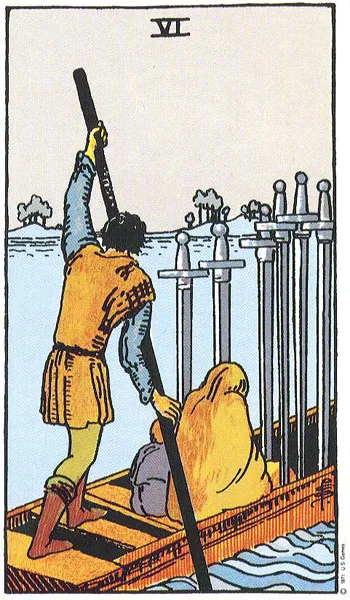
A ferryman stands at the stern of a low wooden boat, poling it across a wide stretch of water. His passengers, a cloaked woman and a small child, sit huddled with their backs to us, faces hidden. Six swords stand upright in the bow of the boat, planted like fence posts, traveling with them. The water on the near side of the boat is rippled and disturbed; ahead, toward the far tree-lined shore, it lies smooth. Nobody in the picture looks back.
Six of Swords: upright meaning
You are already in the boat. That is the quiet news of the Six of Swords: the hardest part, deciding to leave, has happened, and what remains is the crossing, unglamorous, a little sad, and genuinely forward. This card covers moves of every scale: leaving a job, a relationship, a city, a mindset, a version of yourself that stopped fitting. The swords travel in the bow because you do not get to leave your history on the dock; you carry what you learned, and it ballasts the boat rather than sinking it. Mercury in Aquarius flavors the passage with clear, forward-facing thought, decisions made from perspective rather than panic. The water ahead is smoother. Not paradise, smoother. Right now, smoother is enough.
Six of Swords: reversed meaning
The boat is loaded and not leaving. Reversed, this card shows a transition stalled, by second thoughts, by unfinished business that genuinely needs closing, or by the undertow of the familiar, which pulls hardest at the exact moment of departure. It can also mark someone who physically left but mentally stayed: new city, old arguments running on loop. Sort your cargo. Some things that feel like reasons to stay are just weight, and some loose ends do deserve an honest knot before you go. Tie those, drop the rest, push off.
Six of Swords: love & relationships
Upright
Movement out of troubled waters, together or alone. For couples, it marks leaving a rough chapter behind, often literally, a move, a fresh context, a joint decision to stop re-fighting the past. For singles, it is the genuine departure from an old attachment. Grief rides along quietly. Let it. It is lighter than it was.
Reversed
A departure that keeps not happening: the relationship you have left three times, the ex who is still your first thought, the couple who moved cities to escape a problem that lives between them, not around them. Reversed asks what unfinished conversation is anchoring the boat, and whether it needs finishing or just releasing.
Six of Swords: career & money
Upright
A transition that improves things: a job change, a handover, a relocation, a pivot away from work that has been grinding you down. It rarely feels triumphant in the moment, more like relief with a side of nerves, but the trajectory is sound. Financially, it favors steadily moving away from what drains and toward what sustains.
Reversed
You know the job or direction is done, and you are still there. Fear of the crossing, not love of the shore, is what is holding you. Alternatively, a planned move hits real logistical snags: delays, dependencies, paperwork. Distinguish obstacle from excuse honestly, solve the first kind, and stop feeding the second.
Six of Swords: yes or no?
Yes.
A yes, of the quiet kind. The Six of Swords promises improvement through movement, things getting better because you are leaving what made them worse, so questions about changes, moves, and fresh starts get a clear green light. It is a gradual yes rather than a fireworks yes. The far shore is real, and you reach it by degrees.
Related cards
Frequently asked questions
Would this card find you today?
Pull this card in a live reading →