Major Arcana · 13
Death Tarot Card Meaning
- Upright
- endingstransformationreleasetransitioninevitable change
- Reversed
- resisting an endingstagnationprolonged goodbyefear of change
- Yes or No
- No
- Element
- Water
- Astrology
- Scorpio
What the card shows
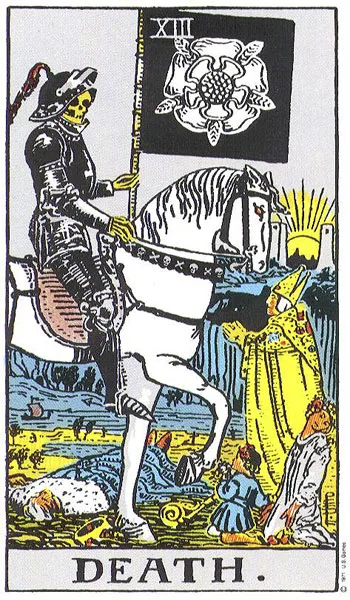
A skeleton in black armor rides a white horse at a slow, unstoppable walk, carrying a black banner blazoned with a white five-petaled rose. Beneath the hooves lies a fallen king, his crown toppled in the dust; a bishop clasps his hands, a woman turns away, and only a small child faces the rider openly, offering flowers. On the horizon, between two towers, the sun sits at the waterline, and a river carries a small boat quietly past it all.
Death: upright meaning
Something in your life is ending, and the card's real news is that it is supposed to. Death almost never means physical death in a reading; it marks the close of a chapter whose time is genuinely up, a job, a relationship, an identity, a long phase of life, and it arrives on the white horse's schedule, not yours. Notice the banner's rose and the sun on the horizon: the image is full of what comes after. Resistance is the only thing this card punishes. Grieve honestly, release cleanly, and the space that opens will be larger than what left. Transformation is not optional here, but it is survivable, and it is yours.
Death: reversed meaning
The ending has already happened and is not being accepted, that is the usual truth of Death reversed. A relationship over in everything but name, a job mourned at the desk it is still done from, an old self carried around like furniture from a house you no longer live in. Stagnation is the cost: nothing new can land on an occupied runway. Sometimes the card shows change arriving in slow motion, drawn out precisely because it is being fought. The task is not to feel ready, nobody feels ready. The task is to stop reanimating what has finished, one honest goodbye at a time.
Death: love & relationships
Upright
A relationship phase is ending: sometimes the relationship itself, more often its current form, the honeymoon, an old dynamic, a version of the two of you that has run its course. What survives this card tends to be transformed and sturdier. Singles may need to bury an old attachment before anything living can take root.
Reversed
An ended thing is being kept on life support, an ex not released, a dynamic both of you know is finished, a breakup rehearsed for months and never spoken. The prolonged goodbye is costing more than the clean one would. Whatever you are still holding, holding it is the wound now.
Death: career & money
Upright
A role, business chapter, or professional identity is closing out, layoff, pivot, an industry moving on, a career you have outgrown, and the transition, however unwelcome, is clearing ground. Financially it favors cutting genuine dead weight: the failing venture, the sunk cost, the subscription-shaped drains. Prune, and the living parts get the resources.
Reversed
You are staying past the end, in a dying role, a doomed project, a business model everyone quietly knows is over, because leaving feels like failure. It is not; it is sequencing. The longer the necessary ending is deferred, the more it takes with it. Begin the exit you have been postponing.
Death: yes or no?
No.
As a verdict, Death is a no, the situation you asked about is ending or needs to end, not continuing in its current form. But it is the most constructive no in the deck: this door closes so that a better-fitting one can open, and the refusal is about the old shape, not about you. Let it end. The next question you ask will have a different answer.
Related cards
Frequently asked questions
Would this card find you today?
Pull this card in a live reading →