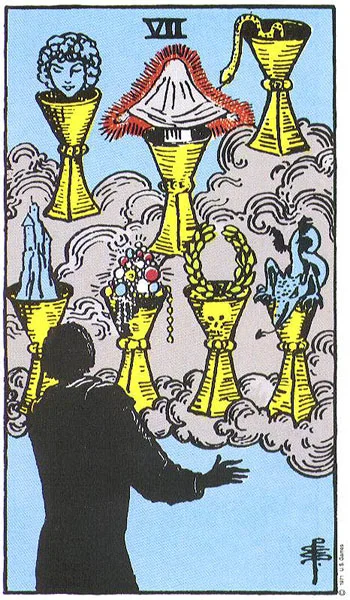
Suit of Cups · 7 of Cups
Seven of Cups Tarot Card Meaning
- Upright
- optionsfantasywishful thinkingchoice paralysisillusion
- Reversed
- claritydecision madeillusions dissolvingsober choice
- Yes or No
- Maybe
- Element
- Water
- Astrology
- Venus in Scorpio
What the card shows
A silhouetted figure stands before a bank of cloud on which seven cups float, each holding a different vision: a human head, a veiled glowing figure, a serpent, a castle on a crag, a heap of jewels, a laurel wreath — with a faint skull shadowed on that cup's side — and a dragon. Nothing in the scene is solid; the cups rest on vapor, and the dreamer is shown from behind, mid-gaze, choosing nothing. Every option glows. At least one of them bites.
Seven of Cups: upright meaning
Seven doors, all imaginary until you walk through one. The Seven of Cups is the intoxication of options — career paths, lovers, cities, versions of yourself, each shimmering exactly as brightly as the others because none has been tested against reality. Venus in Scorpio wants everything, deeply, at once. There is real gift here: imagination this fertile is where every future starts, and some seasons are rightly for dreaming wide. But the card usually arrives when browsing has replaced choosing — when fantasy about all seven lives has become the excuse for living none of them. The cups float on cloud for a reason. Pick one, pour it into the world, and let the other six evaporate as gracefully as they arrived.
Seven of Cups: reversed meaning
Reversed, the fog burns off. This is most often the clarity card: the moment you stop scrolling possibilities and choose, the moment a glittering option reveals its skull, the sober morning after a long season of maybe. Values reassert themselves — of the seven cups, you suddenly know which two were ever really yours. Occasionally it points the other way: fantasies proliferating into genuine escapism, choice paralysis hardening, or being deceived by an option someone else keeps polishing for you. But mostly the reversal is graduation. You have seen enough visions. The remaining work is picking one and surviving its ordinariness — because the real version of anything is smaller than its preview, and better.
Seven of Cups: love & relationships
Upright
Too many maybes, or one person seen through fog. Dating apps at full churn, options kept warm, a crush built mostly from projection — this card asks whether you are in love with a person or with a preview. In relationships, fantasy comparison is the hazard: measuring a real partner against imagined alternatives is a contest reality always loses. Choose with your eyes open, then commit to what you chose.
Reversed
The fog lifts on a connection: illusions about someone dissolve, and you finally see what is actually there — which is sometimes disappointing and sometimes far better than the fantasy version. Choice paralysis in love ends; one option becomes obviously real. If you idealized someone, expect the correction. If you were the one idealized, expect to be seen. Both are ultimately good news.
Seven of Cups: career & money
Upright
Opportunity overload: several paths, projects, or business ideas all glittering, none committed to. Vision-stage thinking is genuinely valuable now — brainstorm wide, imagine hard — but flag the deadline where dreaming must become one funded, scheduled plan. Financially, beware options that shimmer: too-good investments, ventures pitched in preview form. At least one cup in the spread of offers contains the serpent.
Reversed
Decision time arrives and, surprisingly, feels like relief. The career fog resolves into one or two real options; a seductive opportunity reveals its catch before you sign, which is the cheap way to learn it. Cut the fantasy projects that have survived on potential alone. Focus is this reversal's gift — accept it before the cloud bank reassembles.
Seven of Cups: yes or no?
Maybe.
Maybe — the most literal maybe in the deck. The Seven of Cups is unmade choice and untested possibility, so it cannot honestly answer yes or no: the outcome genuinely depends on a decision you have not committed to yet. It often also hints the question itself is built on a fantasy version of the situation. Clarify what you actually want, choose it out loud, and ask again — the answer firms up remarkably fast once you do.
Related cards
Frequently asked questions
Would this card find you today?
Pull this card in a live reading →